




MUSCAT: Oman Chamber of Commerce and Industry’s (OCCI) investment portfolio grew 45 per cent to RO 67.1 million between 2022 and 2025, strengthening its ability to fund programmes supporting the private sector, its chairman said.
The portfolio increased by about RO 20.7 million from RO 46.4 million at the end of 2022, Faisal bin Abdullah al Rawas, Chairman of OCCI’s Board of Directors, told the “Partners in Achievement” forum on Sunday.
Al Rawas said the growth strengthened OCCI’s financial position and its capacity to implement initiatives aimed at improving private-sector competitiveness and expanding business and investment opportunities.
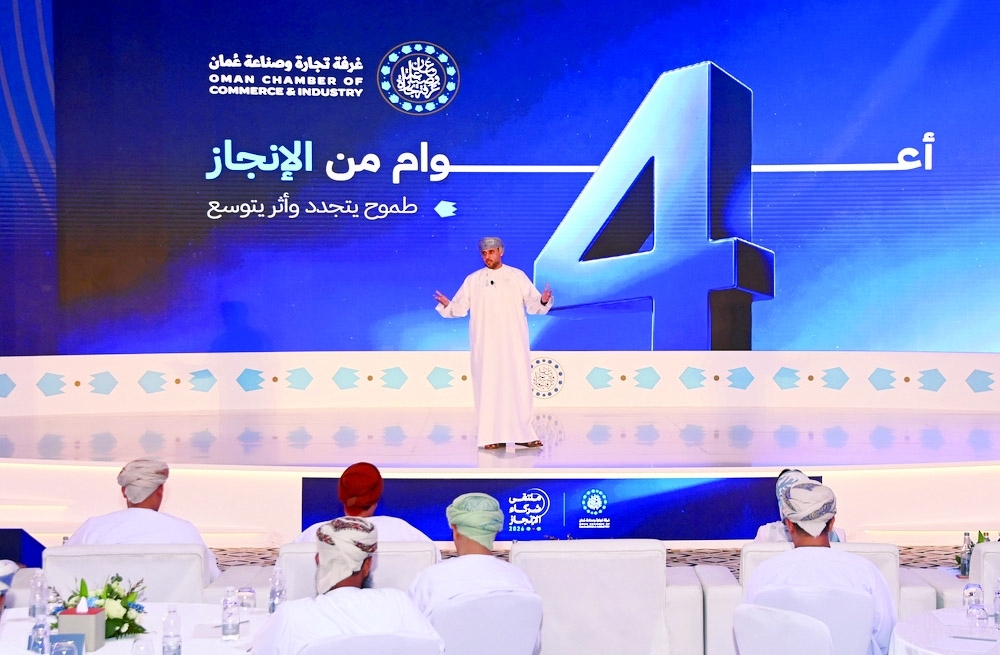
The forum reviewed the chamber’s achievements during its 2022–2026 board term and honoured members of its sectoral committees for their contributions to improving the business environment.
OCCI also unveiled the design of its planned headquarters at Madinat Al Irfan in Muscat Governorate.
The building will include smart workspaces and modern conference and event halls to accommodate trade delegations and economic gatherings. Its design is targeting LEED and WELL certifications covering sustainability, indoor environmental quality and users’ well-being.
Al Rawas said the project reflected the expansion of OCCI’s responsibilities and services as the chamber sought to strengthen the private sector’s role in economic development.
OCCI introduced 35 regulations and updated three others in 2026, bringing the total number of new and revised regulations to 38. The measures are intended to improve internal operations, governance, transparency and institutional oversight.
The chamber has also expanded the role of its governorate branches, which serve as links between businesses, government agencies, investors and private-sector organisations.
OCCI branches conducted about 604 activities, including workshops, seminars, exhibitions, conferences and meetings, between 2023 and April 2026. They also held 1,723 meetings with government agencies, businesses and investors during the period.
Al Rawas said the Sohar Investment Forum was among the chamber’s major initiatives supporting economic development outside Muscat.
The 2024 and 2026 editions attracted more than 1,750 participants from 32 countries and presented 145 investment opportunities worth about RO 1.3 billion. Agreements and memoranda of understanding valued at RO 127 million were signed during the events.
OCCI has sought to connect Omani companies with international markets and prospective foreign partners through trade missions, exhibitions and incoming business delegations.
Between 2023 and June 2026, the chamber received 169 trade delegations, sent 58 Omani delegations abroad and participated in 76 exhibitions in the Sultanate of Oman and overseas.
Al Rawas said these activities had developed beyond external representation into platforms for market access, commercial networking and partnership development.
The chamber also operates specialised centres providing arbitration, product numbering, social investment, franchising, economic research and consultancy services.
The Oman Commercial Arbitration Centre has handled cases worth about RO 138.5 million since it was established in 2021. By the end of 2025, it had registered 128 commercial arbitrators, nine mediators and 56 experts.
The Oman GS1 Centre provides internationally recognised product-numbering services intended to give Omani goods reliable identification and facilitate access to domestic and overseas markets. It registered 383 companies between 2022 and 2025.
The Social Investment Centre works to establish governance frameworks for social investment and entrepreneurship while promoting cooperation among government agencies, businesses and civil society organisations.
The centre signed 18 agreements and memoranda of understanding with public and private organisations and implemented 26 initiatives and projects between 2024 and 2026.
OCCI’s Franchise Centre of Excellence has focused on developing franchising and helping companies and entrepreneurs expand in domestic and overseas markets.
Since its establishment in 2023, the centre has delivered five editions of its franchising programme. Participation increased from 155 people in the first edition to 3,400 in 2026.
The centre has also facilitated more than 220 franchise agreements involving brands from 22 countries.
OCCI’s Economic Research and Studies Centre produced 149 reports and studies and provided 116 economic consultations between 2023 and April 2026.
The centre supports economic policymaking, business-environment improvements and growth initiatives while providing specialist consultancy services.
OCCI also launched the Omani Financial Manager programme with the Institute of Chartered Accountants of India in 2023.
The programme provides training in accounting and financial systems, resource and risk management, financing, budgeting and strategic planning. Seven editions were held across five governorates between 2023 and 2026, attracting more than 385 participants.
The chamber has strengthened its international economic representation through trade offices in Taipei and the United States. The offices promote trade and investment opportunities, help Omani companies access overseas markets and facilitate partnerships with foreign businesses.
Oman’s trade office in Taipei processed 3,073 certified documents, conducted 47 visits and meetings with officials and investors, and participated in 49 events between 2023 and April 2026.
More than 423 people, including over 130 Omanis and 293 Americans, benefited from the US trade office’s activities and seminars over the past year.
The office provided 256 consultations, held 153 meetings with business officials from both countries, participated in 27 exhibitions and trade events, and organised eight virtual workshops.
Zakariya bin Abdullah al Saadi, Chief Executive Officer of OCCI, said the chamber began its current term by establishing clearer strategic priorities covering the business environment, economic diversification, governorate development, governance and digital transformation.
A workshop organised to develop those strategic directions drew more than 300 participants and representatives from 20 government and private-sector organisations.
Al Saadi said digital transformation was a central pillar of OCCI’s strategy. The chamber is developing its technical infrastructure and electronic services to improve operational efficiency, enhance user experience and facilitate access to economic information.
The programme is intended to make OCCI more agile and better able to anticipate economic changes, while complementing reforms to governance and performance-management systems.
Those reforms include clearer authorities and responsibilities, updated policies and procedures, performance indicators, greater transparency and accountability, and measurements of the actual impact of programmes and initiatives.
Al Saadi said OCCI had developed an integrated method for designing programmes, initiatives and specialist events.
Its planning takes account of Oman Vision 2040, the chamber’s responsibilities under Royal Decree, board directives, strategic goals and the requirements of the private sector.
The process also draws on input from sectoral committees, chamber branches and the wider business community, as well as local, regional and global economic developments and opportunities in emerging industries.
Proposed events are assessed according to their alignment with economic priorities, national importance, potential number of beneficiaries and ability to generate investment, trade, partnerships and knowledge transfer.
Each event is assigned economic objectives, target groups and sectors, implementing and supervising organisations, resource requirements, performance indicators and expected outcomes at the planning stage.
OCCI has also developed a system for assessing the impact of its programmes and events across three areas: implementation efficiency, benefits delivered to participants and target groups, and wider economic impact.
The framework covers meetings, seminars, conferences, economic studies, trade delegations, exhibitions, training programmes, initiatives and projects.
Follow-up mechanisms are used to track longer-term outcomes, including commercial transactions, investment opportunities, partnerships, knowledge transfer and improvements in institutional performance.
The forum concluded by honouring the chairpersons and members of OCCI’s sectoral committees for identifying challenges facing different industries, proposing business-environment reforms and strengthening communication between the private sector and relevant organisations. — ONA
Oman Observer is now on the WhatsApp channel. Click here